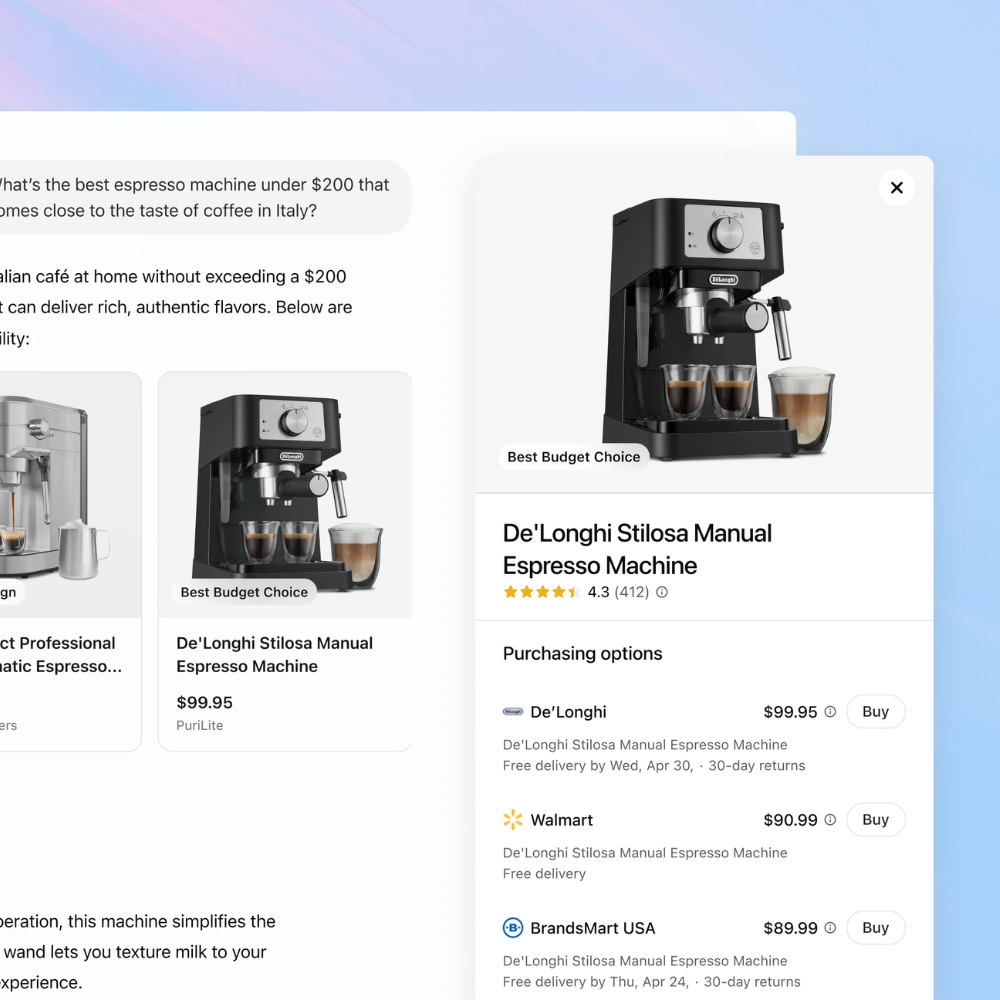
AI is officially coming for product discovery, and ChatGPT is leading the charge. In April 2025, OpenAI announced a new shopping experience directly inside ChatGPT. This experience surfaces curated product listings in response to natural language prompts like “eco-friendly candles under $50.”
If you’re an eCommerce business owner, this shift matters. Not just in a “this is cool tech” way, but in a “this is where your customers are starting to search” kind of way.
In this post, we’ll break down how the ChatGPT shopping experience works, why some brands are already showing up (even without paying), and how you can optimize your site to increase your chances of getting discovered.
PREFER TO LISTEN TO THIS EPISODE? CLICK HERE
What Is ChatGPT Shopping and How Does It Work?
ChatGPT’s new shopping feature is an organic, AI-driven product discovery tool. Users can type natural queries like:
- “Best yoga mats for beginners”
- “Non-toxic candles under $50”
- “Stylish gifts for a mom who loves gardening”
Instead of just linking to a blog or a generic search engine results page, ChatGPT may now respond with actual product listings, complete with:
- Product images
- Short descriptions
- Summarized reviews
- Feature labels (like “eco-friendly” or “editor’s pick”)
- Links to multiple retailer options for purchase
These are organic, not paid, and OpenAI has stated they do not earn commissions, at least for now. ChatGPT chooses which listings to show based on content relevance, structured data, and user intent.
Think of it as Google Shopping meets a smarter-than-average product concierge.
What I Learned Testing ChatGPT’s Shopping Experience
To see how it worked in the wild, I ran a few test searches.
When I typed, “I want to find a gift for my mom,” the result was a collection of curated gift guides and articles — a more editorial content curation experience.
But when I searched “eco-friendly candles under $50,” things got interesting. ChatGPT returned a carousel of product listings from real brands. One of them? PF Candle Co. But their official website was listed second — the top result was a smaller retailer I hadn’t heard of.
That’s huge.
It shows that big names don’t automatically get top placement. Instead, ChatGPT prioritizes relevance, clarity, and structured content.
A Real Small Business Win — Long-Tail SEO in Action
One of the coolest parts? One of my Lounge members is already showing up in ChatGPT shopping results.
When I searched using a generic version of her product category, she didn’t appear. But once I refined the query into a long-tail search, two of the five listings were hers.
Even better? ChatGPT linked to her Shopify store, not her Etsy listing.
She didn’t do anything “special.” Just solid on-site SEO:
- Clear product titles
- Descriptive copy with the same language her customers use
- Schema-enabled product pages
- Reviews that reinforced product credibility
So yes, small brands can absolutely win here, especially when they target long-tail keywords that their ideal customer is actually searching for.
How Does ChatGPT Choose Which Products to Feature?
ChatGPT doesn’t use a merchant-submitted product feed (yet). Instead, it crawls the web using its own bot: OAI-SearchBot, to find products to feature in ChatGPT
- Structured data (schema markup)
- Product relevance to the query
- Customer-friendly content
- External validation, like reviews or backlinks
If you want to future-proof your store, you can submit your interest in participating when feeds open up using OpenAI’s form.
There’s also speculation that a Shopify integration may be coming, likely through a new sales channel similar to what we’ve seen with Pinterest or TikTok. It hasn’t been confirmed yet, but Shopify will almost certainly be one of the first platforms to get it.
SEO Strategies to Help Your Products Show Up in ChatGPT
The best part? You don’t need a new strategy to prepare for this. You just need to double down on your existing SEO fundamentals.
Here’s how to optimize:
1. Use Schema Markup (Structured Data)
If you’re using Shopify 2.0 with a vetted theme, you have basic schema built in. Other platforms handle it differently:
- Squarespace: Has product schema, but doesn’t include reviews
- BigCommerce & Wix: Support structured product data by default
- WooCommerce: Needs a plugin like Yoast or Rank Math
Run Google’s Rich Results Test to check your structured data
2. Optimize Your Product Pages with Long-Tail Keywords
Use the exact phrases your customers type when they’re looking for your product. That includes:
- Pricing terms: “under $50”
- Material callouts: “14k gold,” “non-toxic soy”
- Use case phrases: “for second piercings,” “gift for mom”
Don’t get clever, get clear.
3. Create SEO-Optimized Gift Guides on Your Blog
Gift guides are still one of the top content formats ChatGPT pulls from, especially when a user’s query is less product-specific.
If you sell cozy candles, write a post like: “10 Self-Care Gifts for Busy Moms Under $50” and feature your products naturally.
If you’re on Shopify, you can even embed product blocks right into blog posts without third-party tools (covered in my Shopify Secrets course).
4. Get Featured in External Gift Guides (PR Strategy)
When I searched for “gift ideas,” ChatGPT didn’t just show product listings — it pulled gift guides from other editorial sites.
That’s where good old-fashioned PR comes in. When other websites link to your products in a roundup or review, it sends strong signals to both Google and ChatGPT.
Backlinks = credibility + discoverability.
Not sure how to pitch gift guides? I’ve got resources for that.
- How to Get PR Coverage for Your Product-Based Business with Nora Wolf (Podcast Episode)
- How to Get Holiday Gift Guide Features (Course)*
5. Don’t Forget Your Alt Text and Image Metadata
ChatGPT pulls from visual data too. That means your product photos need to be:
- Compressed and fast-loading
- Labeled with keyword-relevant filenames
Tagged with meaningful alt text (e.g., “lavender soy candle in glass jar”)
ChatGPT Shopping Isn’t the Future — It’s Happening Now
You don’t need to become an AI expert to show up in ChatGPT search results. But you do need to have your SEO foundation in place.
The same things that help your products show up on Google and other search engines also help ChatGPT find you:
- Solid schema markup
- Customer-focused product copy
- Helpful blog content
- Strategic backlinks
If you’re ready to get found, and stay found, this is your cue to finally tackle that SEO project you’ve been putting off.
Listen to the Episode
Timestamps
00:00 Introduction to E-Commerce Assery Podcast
00:58 AI’s Impact on Shopping
02:03 Testing Chat GPT’s Shopping Feature
04:39 How Chat GPT Sources Product Information
05:55 Optimizing Your Products for Chat GPT
07:49 SEO Tips for E-Commerce Success
10:40 Next Steps and Final Thoughts
Links Mentioned
How OpenAI Chooses Products to Feature in Shopping
The New Product Shopping Experience in ChatGPT
Get Updates When OpenAI Releases a Product Feed